
Tarnowski urges residents to pay more attention to county government

Mayor Mike Tarnowski urges Russell Township residents to pay more attention to county government as it collects nearly four dollars out of every ten on their residential property tax bills but often attracts little public attention.
His call comes as the counties face a projected revenue shortfall of nearly $5 million from the delayed opening of their new long term care residence in Hawkesbury. The home began welcoming residents nine days ago, on Oct. 21, and is still admitting people to fill its remaining beds. The financial trouble built up during months of delay. The budget had assumed occupancy would begin in March.
“Even myself when I started on council, I didn’t realize the importance of the counties,” he said in an interview with The Rustler.
Tarnowski said he had not fully appreciated how extensively county government affects daily life in Russell Township including ambulance service, county roads, housing, child care and long term care.
When township council announces a tax increase that tells residents what is happening to only one part of their bill. County council makes its own budget and tax decisions which also affect how much property owners pay.
“Then there’s the whole county side of things that happens and most people don’t pay attention to that whatsoever.”
One bill, three destinations
Both Russell Township and the United Counties of Prescott and Russell set taxes to fund their own responsibilities. Ontario sets the education tax rate. The township sends property owners a combined bill keeping its own portion and passing the respective portions on to the county and local school boards.
For a residential property assessed at $100,000 for tax purposes the 2026 annual bill would be approximately $1,305, excluding water, sewer and other utility charges. Rounded to the nearest dollar, that breaks down as follows:
• $650 for Russell Township, including fire protection.
• $502 for county services.
• $153 for education.
The assessment is the property value used to calculate taxes determined by the Municipal Property Assessment Corporation. It is not necessarily what the home would sell for today. A property assessed at $400,000 would pay four times the amounts in that example.
Approximately $49.78 goes to the township, $38.50 to the counties, and $11.72 to education out of every $100 in residential property taxes.
Russell contributes about $17 million
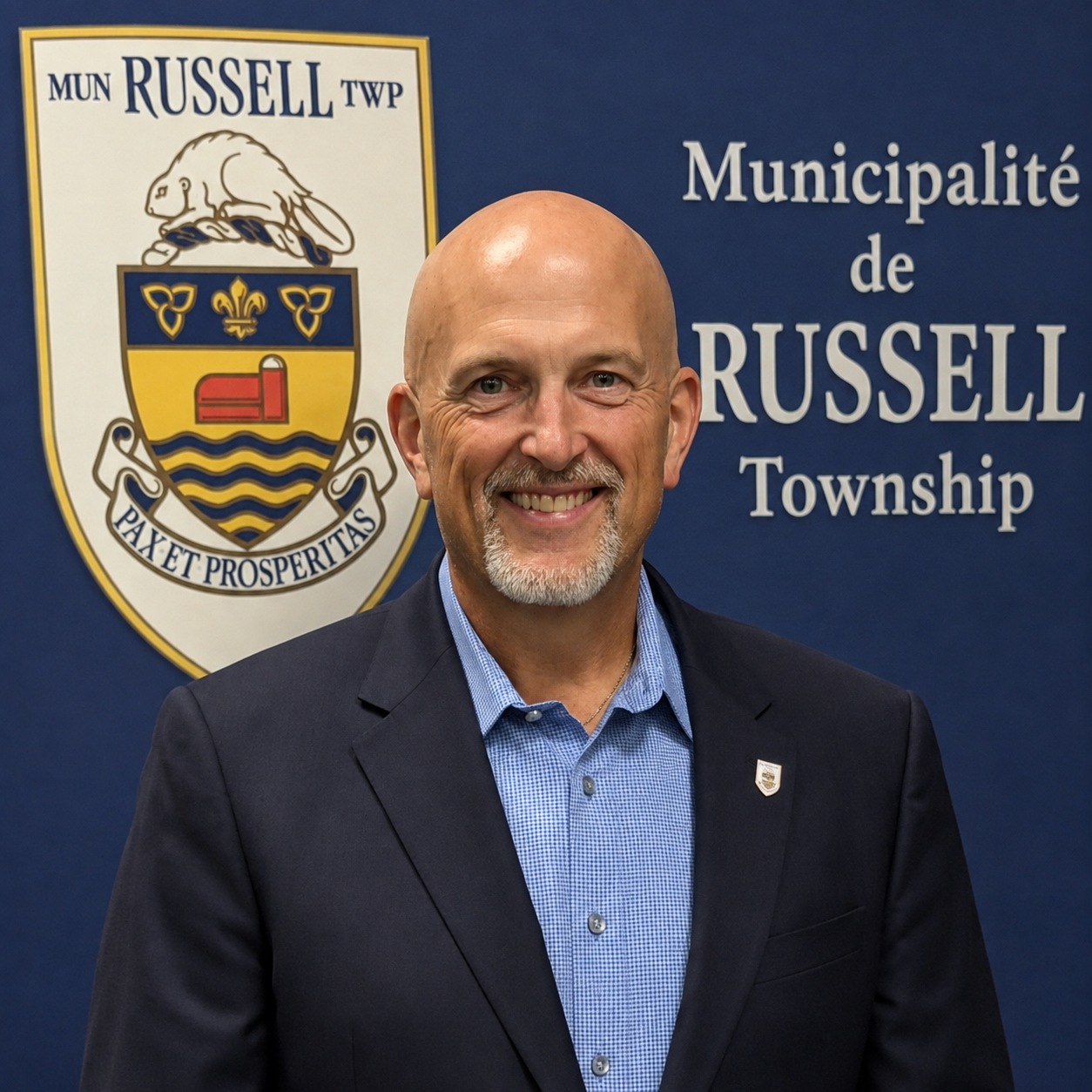
Photo: Russell Township.
Russell Township is expected to provide approximately $17 million in county funding this year collected mainly through the county portion of local property tax bills. That includes taxes on homes, businesses and other taxable properties, rather than homeowners alone.
The total also includes about $35,000 in payments made in place of property taxes on certain otherwise tax exempt properties.
Russell supplies roughly one quarter of the $67.6 million the counties expect to receive through the combined levy and payments in lieu from their eight municipalities. But that does not mean Russell pays a quarter of the entire county budget. Its contribution is equivalent to about 8.3% of the counties’ $203.7 million budget.
The county levy is not divided into eight equal shares among the eight municipalities. Each municipality’s contribution depends on the assessed value and types of properties within its boundaries. The county applies the same rate to the same property class across its municipalities.
Russell has approximately $3.55 billion in taxable property assessment out of $14.49 billion across Prescott and Russell. That large share of the tax base, together with the mix of property classes, explains why its contribution is close to a quarter of the county levy.
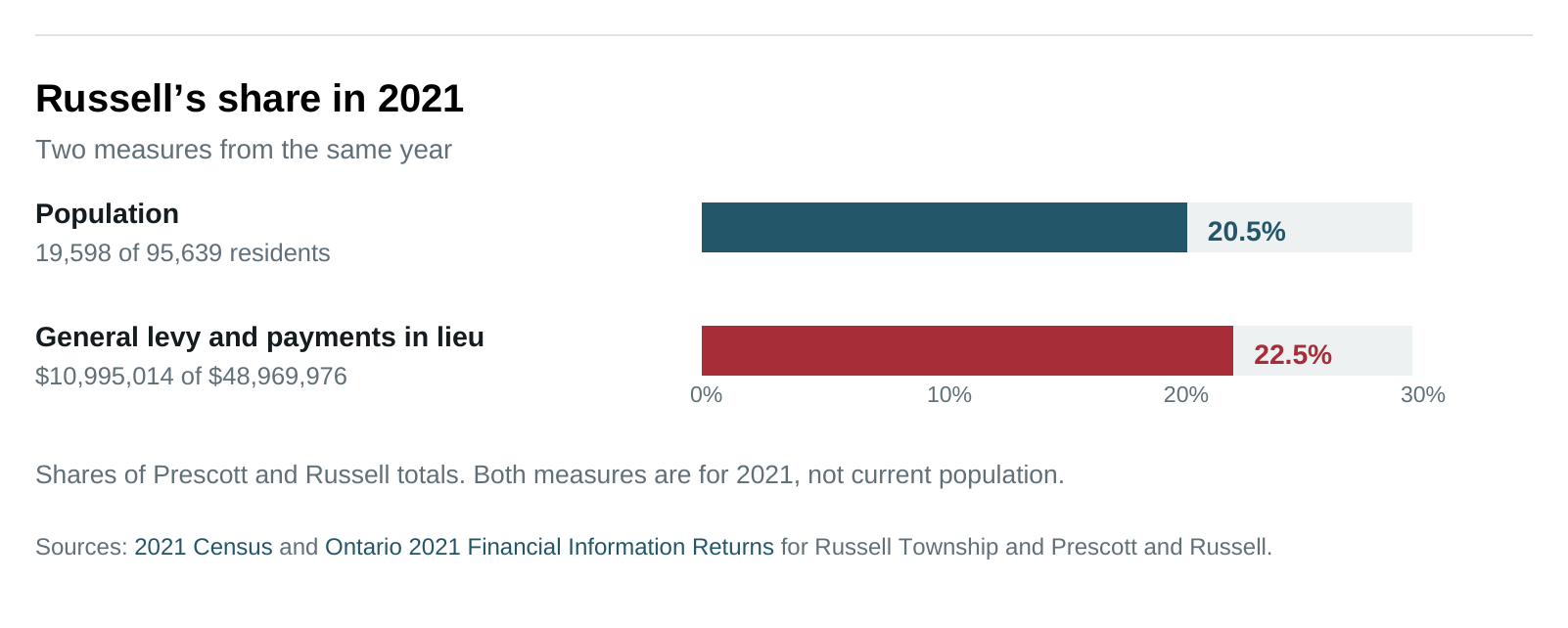
For comparison, Russell Township accounted for 20.5 per cent of the United Counties’ population in the 2021 census and supplied about 22.5 per cent of the county’s general property tax levy and payments in lieu that year.
Where the rest of the money comes from
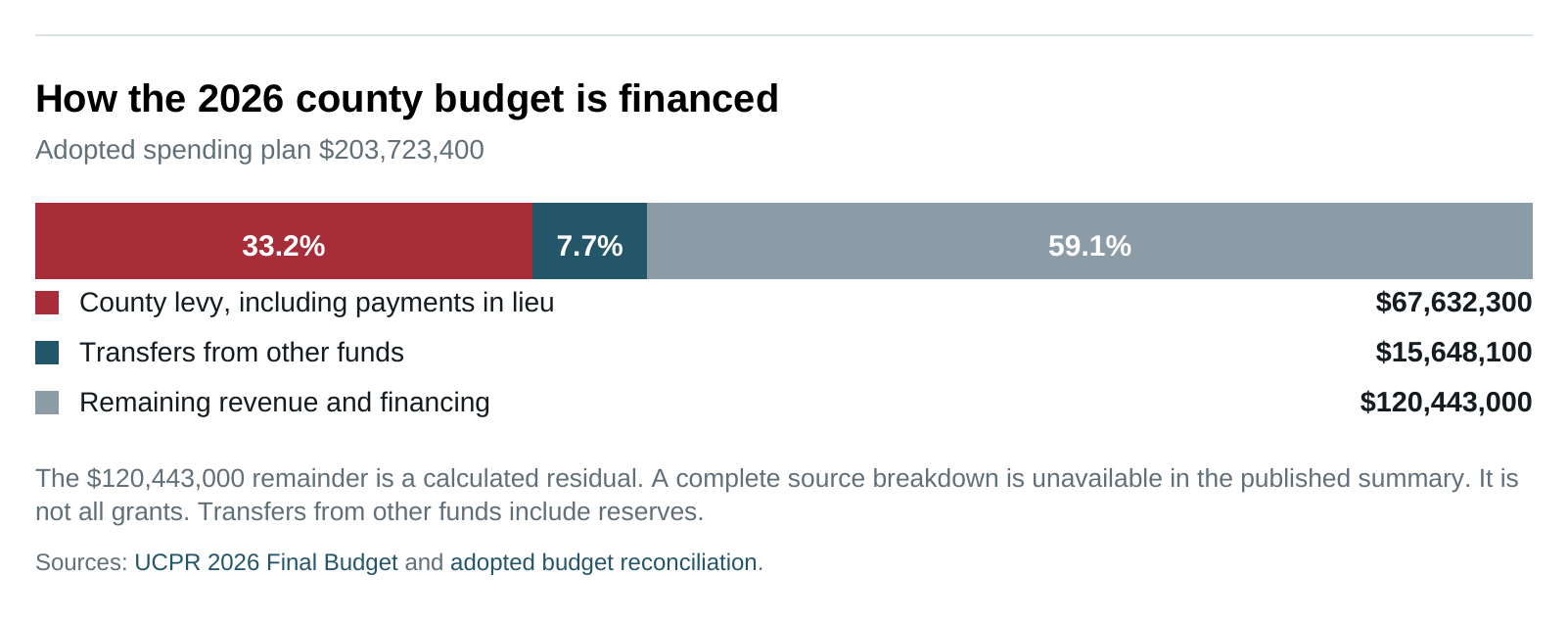
The counties’ adopted 2026 spending plan totals $203.7 million, including capital projects, debt principal and money transferred into reserves.
Its financing includes approximately:
• $67.6 million from the county levy, including payments in lieu of taxes, or 33.2 per cent.
• $15.6 million transferred from other funds, including reserves, or 7.7 per cent.
• $120.4 million in remaining revenues and financing, or 59.1 per cent.
Government funding and fees help support county services however the published summary does not provide a complete breakdown of that remaining $120.4 million by source. Money taken from reserves is previously accumulated funding rather than a new grant from another government.
The distinction matters when looking at individual services because a department’s total budget is not necessarily the amount that must be raised through county property taxes. Its other funding is deducted first, leaving the amount to be covered by the county’s general funding.
Services that cross municipal boundaries
The transportation budget discussed here covers county roads and bridges, including construction and maintenance. It is not a bus service budget.
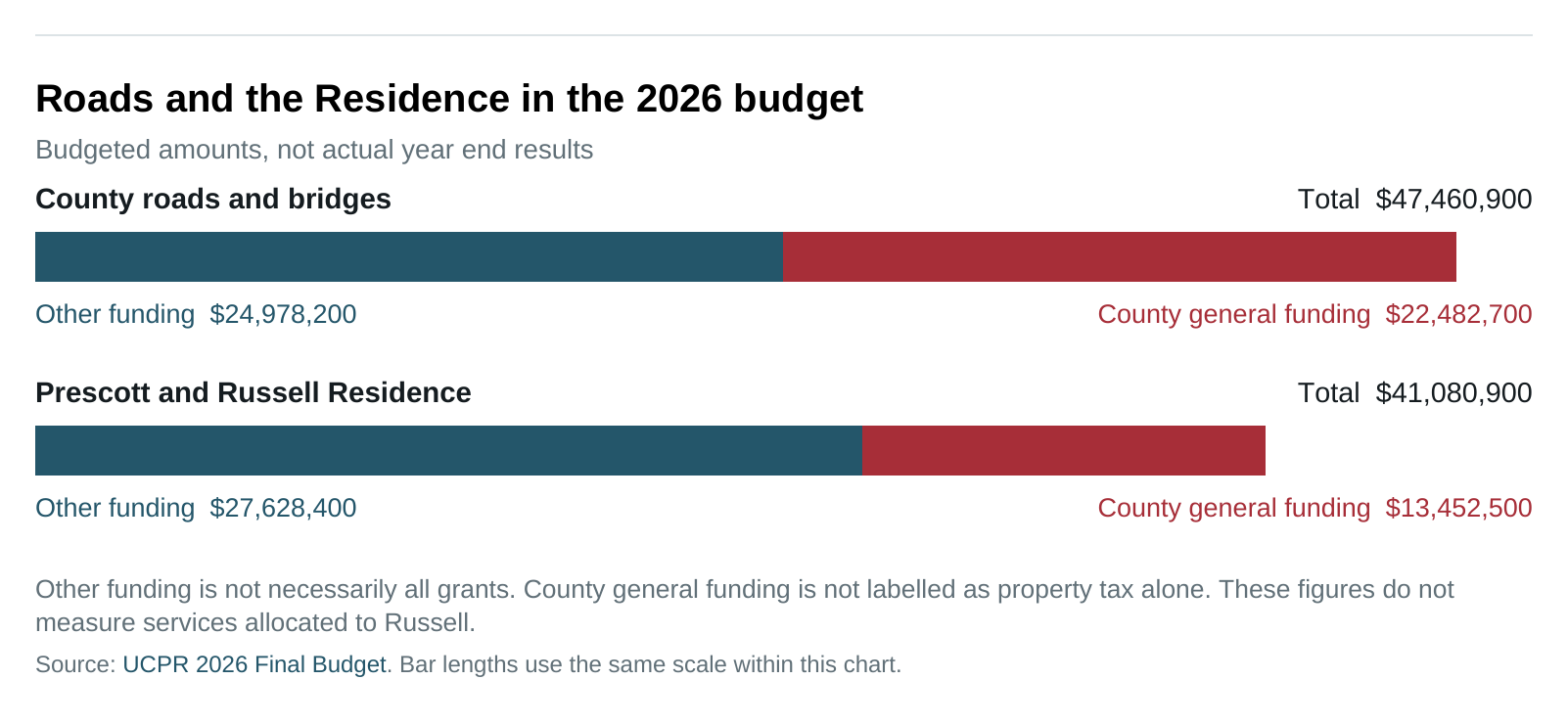
The counties plan to spend $47.5 million on that work in 2026. About $25 million is covered by other budget funding leaving $22.5 million to be covered by the county’s general funding. That other funding must not all be described as grants because the budget also uses sources such as reserves.
The Prescott and Russell Residence has a $41.1 million annual budget. Its budget lists $27.6 million in funding before the county’s general funding is applied, leaving $13.5 million to be covered by that general funding. The summary does not separately identify every source within that $27.6 million.
The Residence shows why the numbers matter
The delayed opening of the new Prescott and Russell Residence offers a current example of the financial decisions residents have a stake in following.
At the Oct. 28 county council meeting, Tarnowski pressed for a forecast showing the expected deficit rather than only a report on spending and revenues to date.
“I’m still disappointed that we don’t have that forecast right now,” he said.
“We are coming in blind to the end of the year.”
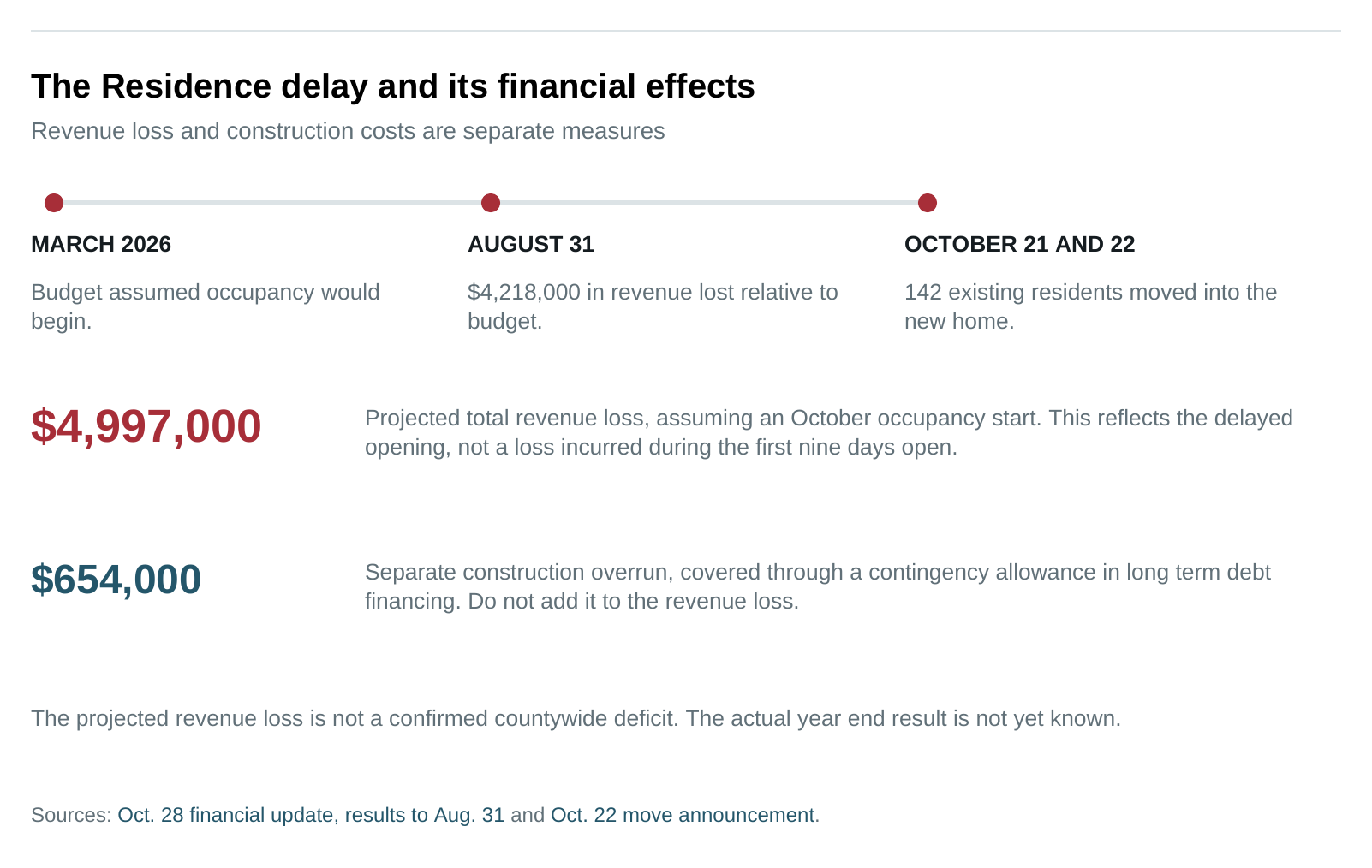
The counties announced that 142 residents moved into the new home on Oct. 21 and 22. The annual budget, however, had assumed occupancy would begin in March.
A financial update presented to county council on Oct. 28 reported that delayed occupancy had reduced revenues by approximately $4.2 million relative to budget by the end of August. It projected a total revenue loss of approximately $5 million, assuming an October occupancy start. That projection is a loss of anticipated revenue associated with the delayed opening not a confirmed countywide year end deficit or an additional bill already imposed on Russell taxpayers.
Tarnowski said the delay also complicated operations, with costs associated with preparing the new home while maintaining the existing facility.
“You can imagine having 2 facilities open at once,” he said.
The financial update separately reported construction costs about $654,000 above the approved project budget. Those costs will be covered through a contingency allowance in long term debt financing. The construction overrun and projected operating revenue loss are different measures.
For Tarnowski, regular reporting is essential to understanding such pressures before the end of the year.
In Friday’s interview, he recalled being surprised by a warning about a deficit after joining county council in 2024.
“It kind of blindsided me at the time,” he said.
He distinguished that experience from this year’s financial pressure, which he said was not entirely a surprise because the Residence’s delayed opening had already been causing problems.
He said the counties were not then providing the quarterly financial reporting he was accustomed to at the township and that council pushed for it.
“Where are we at year to date? What’s the budget? Where are we at compared to budget, compared to last year?” he said, describing the questions councillors need answered.
The October financial update provides a picture of results to Aug. 31 rather than a final year end accounting. It expressly cautions that the reported year to date corporate deficit of $396,422 is not a forecast of the year end position.
Although the long term care home is in Hawkesbury it is a regional service.
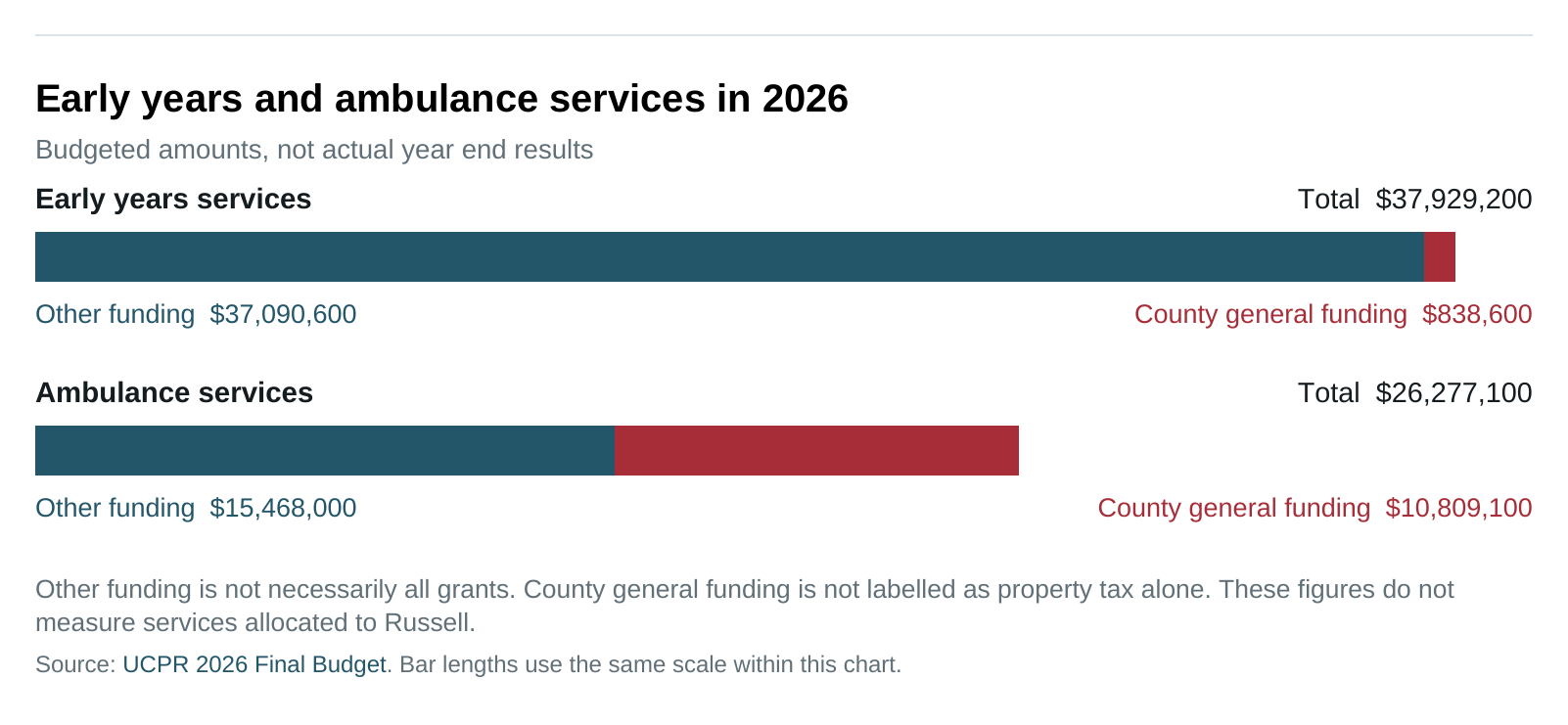
Early years services have a $37.9 million budget for programs and funding that include child care, fee subsidies, inclusion services and EarlyON child and family programs. About $37.1 million comes from the budget’s other funding sources, leaving approximately $839,000 to be covered by the county’s general funding.
Ambulance services have a $26.3 million budget. Other budget funding covers approximately $15.5 million, leaving $10.8 million to be covered by the county’s general funding. For Tarnowski, emergency response illustrates why some services make sense beyond the boundaries of an individual municipality.
“It makes sense to have it managed at a county level right? Because you’re giving service and you don’t care about a municipal boundary here,” he said.
“If someone needs an ambulance you want it as efficient as possible to get there as quickly as possible.”
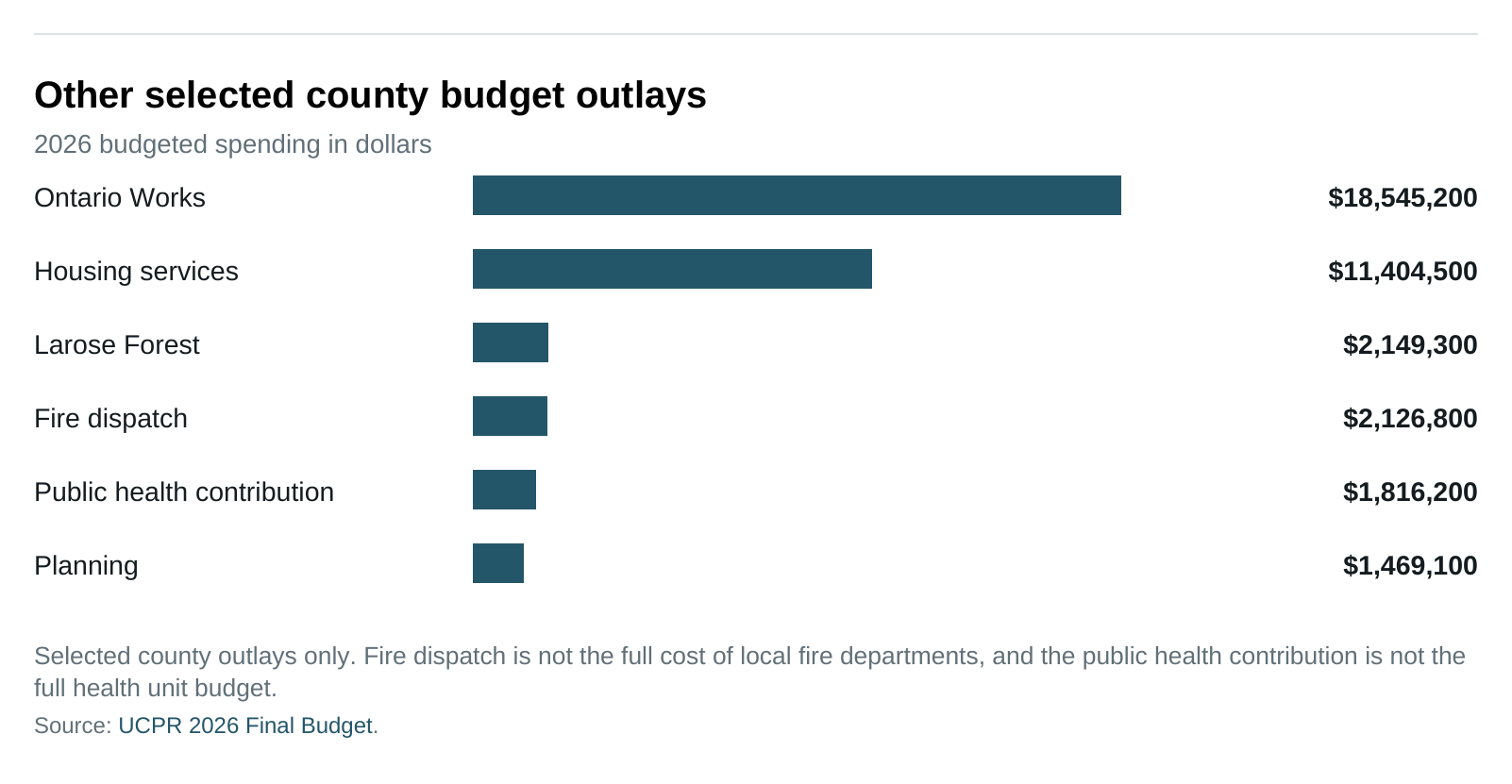
Other county responsibilities include Ontario Works and related assistance, budgeted at $18.5 million, and housing services at $11.4 million. Housing responsibilities include the county’s social housing portfolio, support for non profit and affordable housing, and the centralized waiting list for rent geared to income housing.
The budget also includes approximately $2.1 million each for Larose Forest and fire dispatch, $1.8 million as the county contribution to public health, and $1.5 million for planning.
Those figures describe different services and are not substitutes for all local spending. Fire dispatch is not the full cost of Russell’s fire department. The public health contribution is not the entire Eastern Ontario Health Unit budget. County planning responsibilities operate alongside township responsibilities for such matters as zoning and building permits.
Nor does Russell’s roughly one quarter share of the county levy mean that one quarter of every service is delivered within the township. Regional services pool funding and operate across municipal boundaries. The budget does not establish the dollar value of services received by Russell residents.
Could more services be shared?
Tarnowski also sees interest in examining whether additional services could be organized more efficiently across the eight municipalities.
He said early discussions with newly elected mayors suggest an appetite for looking at economies of scale and pointed to a county level fire services study. That is an examination of possibilities not an announcement that local fire departments will be amalgamated.
“We already have agreements to support each other, but is there a better way?” he asked.
The question, he said, is whether municipalities are making the best use of their residents’ money.
County government’s responsibilities may be less visible than those of the township, but its decisions reach into residents’ daily lives and household tax bills. Tarnowski says that deserves more attention, even while acknowledging the difficulty of attracting it.
“A lot of residents aren’t interested in what’s happening at the municipal level, let alone another level of government.”