
A new wastewater treatment plant at the existing Embrun lagoon site has emerged as the preliminary preferred option for Russell Township and The Nation Municipality as the neighbours plan for growth that their current systems cannot accommodate indefinitely.
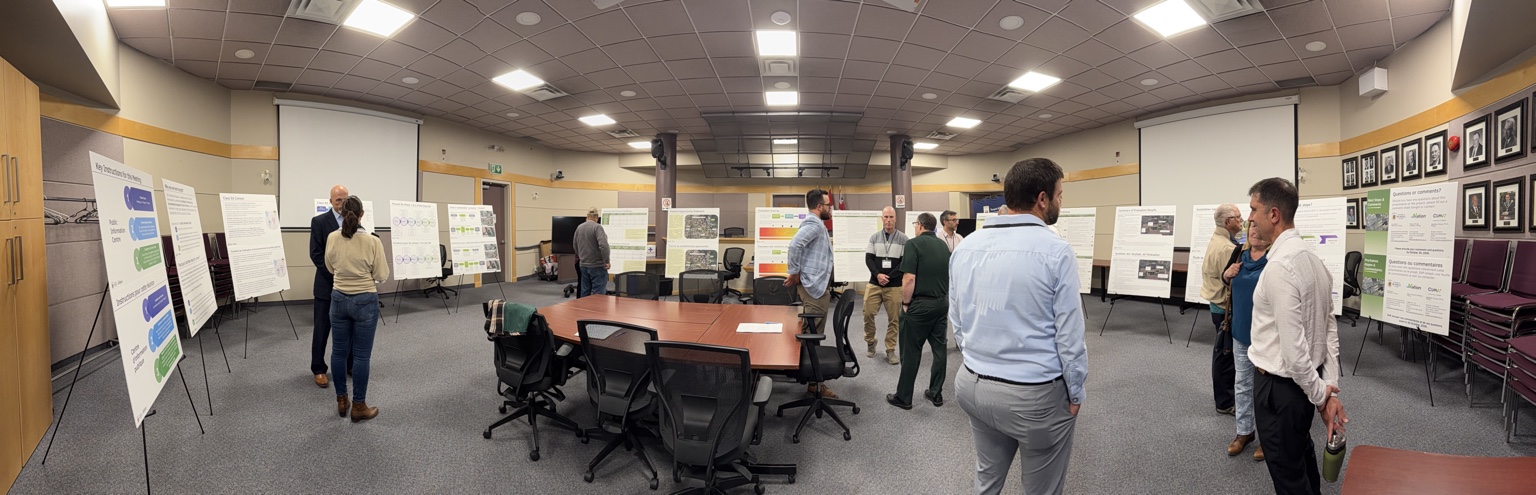
The proposal presented at the Sept. 29 open house in Russell Township's council chambers in Embrun would bring wastewater from Russell, Embrun and Limoges to one consolidated mechanical plant. New pumping stations would be needed in Russell and Limoges. The routes connecting them to Embrun have yet to be developed.
In an interview with The Rustler at the open house, The Nation's chief administrative officer, Pierre Leroux, said combining the work offers economies of scale and potential savings compared with undertaking two major projects independently.
“It just makes a regional approach make more sense,” Leroux said.
Leroux knows both sides of the proposed partnership. Before joining The Nation, he spent more than 13 years on Russell council, including more than nine years as mayor. He described municipal partnerships as familiar territory for The Nation, pointing to its drinking-water partnership with Clarence-Rockland. Proximity to Ottawa is driving growth in both municipalities, he said, with The Nation's expansion concentrated in the west, particularly Limoges.
Their needs are similar but their clocks are not identical. Leroux said Russell needs additional wastewater capacity a couple of years before The Nation. He said planning has to begin four to six years ahead because of the time required to bring this kind of infrastructure into service.
Russell Mayor Mike Tarnowski estimated Russell was four to five years from approaching lagoon capacity.
“Where the urgency is now is wastewater,” he said.
Councillor Lisa Deacon said the open house was helpful because engineers and The Nation’s staff together in one place made it possible to compare their systems, projections and reasons for pursuing the project.
“We have very different systems and very different needs right now but the timing works well for both as I understand.” How the partnership develops over time will depend in part on how closely actual growth follows the forecasts, she said.
The public display boards identified two linked problems. Existing lagoon-based systems need significant upgrades to meet effluent limits and they cannot serve the anticipated growth over the study’s medium-term timeline. The assessment built on master plans already completed by the two municipalities.
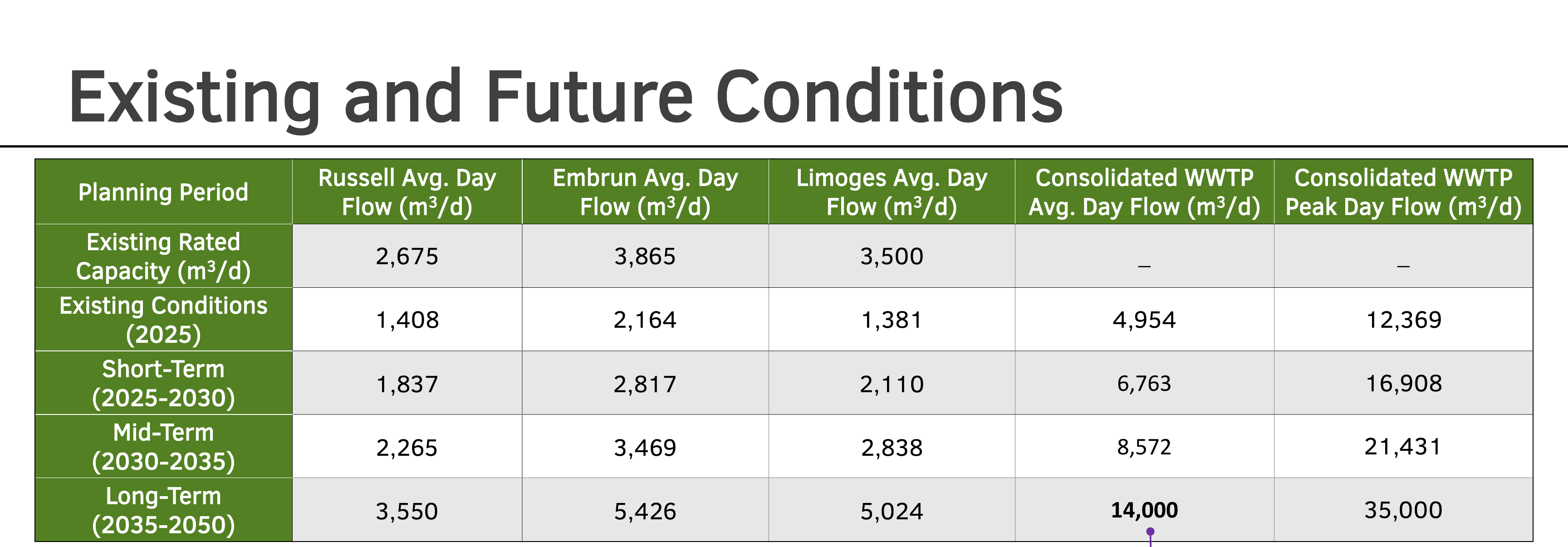
See all the information panels that were set up at the meeting.
Russell and Embrun currently rely on lagoon treatment before treated effluent is discharged to the Castor River. Limoges has additional treatment stages, including removal of large material and grit, biological treatment, filtration and ultraviolet disinfection. The proposed regional facility would only serve those three communities.
The study compared expanding treatment at all three existing sites with consolidating it at Russell, Embrun or Limoges. Embrun ranked highest in the preliminary evaluation because of its central location and larger projected population. It reduced the amount of wastewater that must be pumped over long distances. And makes use of existing municipal land and infrastructure.
Tarnowski favours mechanical treatment partly because it can be expanded in modules as more capacity is needed. The study has not yet selected the technology for the proposed plant. The next stage will compare treatment technologies and design concepts alongside the routes needed to bring wastewater to the site.
Establishing the plant in Embrun would have the lowest capital investment among the feasible alternatives largely because it minimizes pumping and conveyance requirements. The comparison does not give a dollar price for the preferred plant, a cost-sharing formula between municipalities or an estimate of its effects on household bills.
The comparison anticipates disruption during construction of the plant and connecting pipes, along with some additional truck traffic during the operations. It also identifies occasional odours at the existing Embrun site as something the new facility would address. The map shown at the open house is conceptual with pipeline routing still to be worked out.
The Castor River’s importance to the design of the project has prompted an assimilative capacity study that has been completed to assess the river’s ability to receive greater volumes of treated effluent while maintaining its health. Its findings will inform discharge requirements and capital planning for the plant. The summary does not publish the study's detailed numerical limits.
Tarnowski said Russell and Nation are seeking provincial support with backing from MPP Stéphane Sarrazin and that Russell began setting money aside in previous years’ budget. He described wastewater as a major upcoming investment, comparing the advance saving to the township's approach to its recreation complex.
He connected the request to the province's housing ambitions. “We want to be part of that within reason, obviously, on the growth side, but we need support for that because, you know, in three, four years, we're going to be limiting housing development.”
He also pointed to the way water and sewer services are paid for by their users, saying a larger customer base can spread costs. That argument leaves the eventual financing and rate effects to be worked through as the proposal develops.
The link between growth and municipal servicing has a local precedent. Before Russell and Embrun received Ottawa drinking water, a 2008 regional source-protection report identified the prospective connection as a long-term answer to future growth. Russell's 2024 water and wastewater master plan records that the township relied on local groundwater before 2010 and switched to Ottawa water amid concerns about the source's quality and quantity.
Tarnowski identifies wastewater as the most urgent capacity issue for Russell. The shared-plant proposal would address what happens after water is used, treating sewage for discharge to the Castor River. Its shape will depend on the next round of engineering and public review. Residents have until Oct. 30 to submit comments on the first consultation, with another public information centre targeted for the second quarter of 2027.
Questions and comments can be sent to Russell's Jonathan Bourgon at JonathanBourgon@Russell.ca, The Nation's Marc-Olivier Gratton at MOGratton@nationmun.ca, or CIMA+ consultant Bradley Young at bradley.young@cima.ca.