
Russell Township votes to restrict social media comments after censorship debate
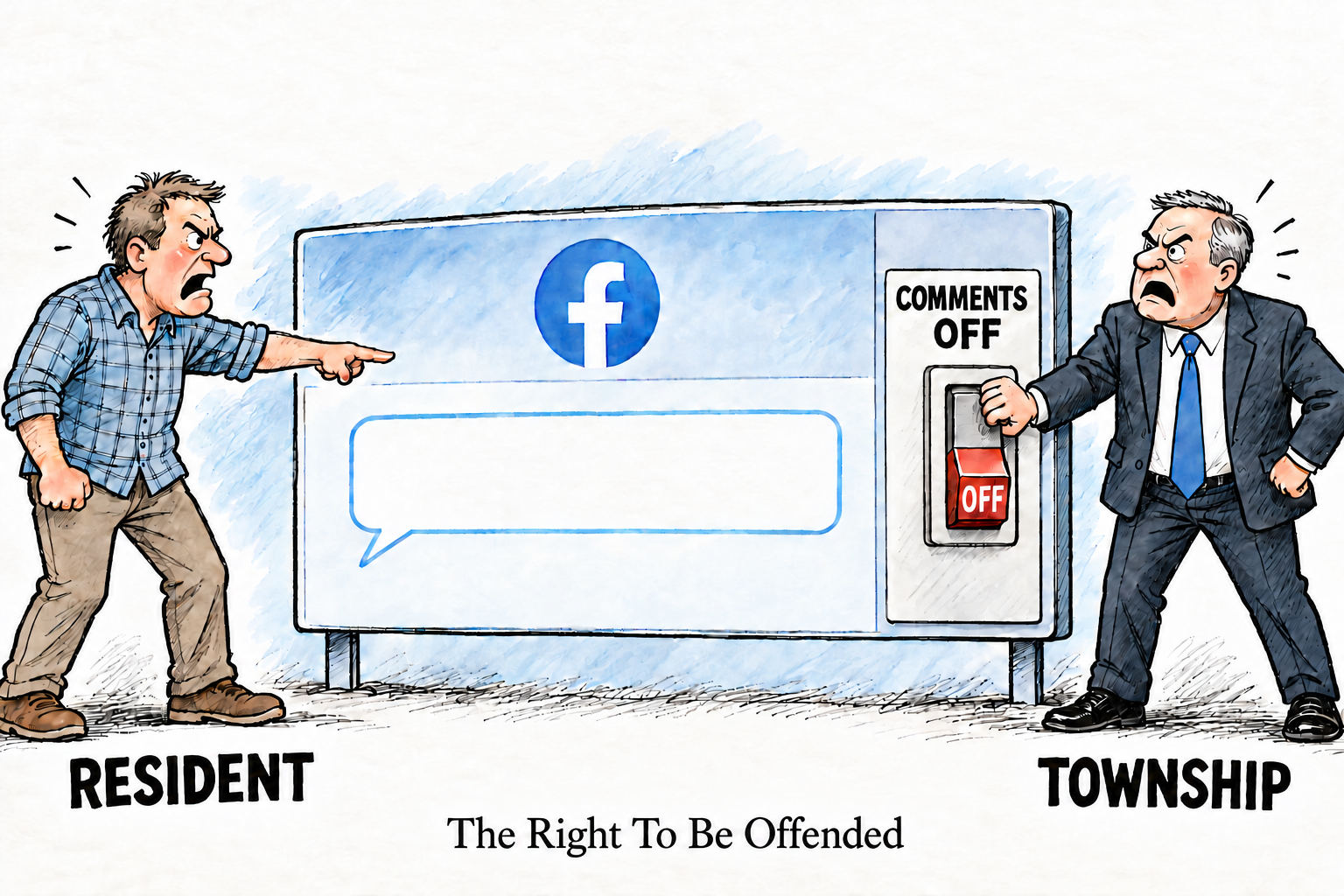
Russell Township will restrict comments on its social media platforms after a lengthy council debate Sept. 28 over where a municipal government should draw the line between encouraging public discussion and moderating comments it considers discriminatory.
The decision came after Coun. Charles Armstrong raised the case of a resident whose Facebook comment on a Township post marking Bisexual Visibility Day had been removed. What began as Armstrong’s request for a review of the Township’s social media policy and its compliance with freedom-of-expression protections ended with council deciding to restrict comments on its platforms.
Coun. Jamie Laurin said that “going forward, all social media comments be restricted,” meaning “any of our platforms.”
The debate exposed a basic tension in municipal communications over whether a Township Facebook page should function as a public discussion forum or primarily as a place where the municipality distributes information.
Armstrong brought the issue to council after being contacted by a resident. He described the original Facebook comment saying the resident had expressed the view that sexuality was not municipal government business and that the Township should concentrate on local services and infrastructure. Armstrong then read the Township’s response to the resident. According to the response he quoted, the Township told the resident the comment violated its social media terms of use and had therefore been removed.
“This serves as a warning,” the Township message said, according to Armstrong. The response also said the Township was proud to be inclusive and recognized cultural and other designated days. It concluded by telling people who did not support a cause to “keep scrolling.” Armstrong objected both to the deletion and to the tone of the response.
“Our terms of use state, ‘The township invites community members to post, share, discuss, and debate,’” he told council.
“It seems from the township response that this is not really true.”
Armstrong went considerably further, describing the Township’s actions as censorship and invoking “the thought police and Big Brother.” He argued that debate necessarily includes disagreement and sometimes offence. “There is no right not to be offended,” Armstrong said.
Armstrong cited the Canadian Charter of Rights and Freedoms, Ontario’s Human Rights Code and the Supreme Court of Canada’s 2021 decision in Ward v. Quebec (Commission des droits de la personne et des droits de la jeunesse). He quoted the ruling as saying that “protecting a right not to be offended has no place in a democratic society.”
He also referred to Ontario’s Human Rights Code. Section 13(2) states that the prohibition against publishing or displaying public notices, signs or similar representations indicating an intention to discriminate or inciting others to infringe protected rights “shall not interfere with freedom of expression of opinion.”
“The township response is in violation of the citizen’s rights under the Charter,” Armstrong told council.
The Ward decision did not consider municipal Facebook moderation or determine whether an Ontario municipality violates the Charter by deleting comments from a social media account. The case involved a comedian’s expression and Quebec human-rights legislation.
Armstrong asked council to direct administration to review Russell’s social media terms of use against the Charter and Ontario Human Rights Code. Township administration strongly disputed his characterization of what had happened.
CAO Richard Godin said staff had followed the communications policy and social media terms of use adopted by council. He referred to three incidents and “multiple layers of review” of the comments. He characterized comments involved in the matter as discriminatory, declined to repeat the words publicly and offered to provide councillors with copies.
“There’s multiple layers of review that were done of the comments,” Godin said, describing material involved in the case as “clearly discriminatory and not acceptable” to leave on the Township’s social media.
Mayor Mike Tarnowski asked whether the comments ran contrary to the Township’s diversity, equity and inclusion principles.
“That’s correct,” Godin replied. “There was some discriminatory comments.”
Armstrong therefore presented the controversy as involving the removal of an opinion about the proper role of municipal government, while administration told council there was more to the record and characterized comments involved in the case as discriminatory.
The Rustler has not obtained the full removed comments or the complete moderation record.
Laurin asked Godin whether Russell Township was required to allow comments on its posts.
“No, we don’t, Councillor,” Godin replied.
Tarnowski said the Township had discussed before whether its social media pages should be places for debate.
“A lot of municipalities,” he said, use social media “as a communication tool,” sending information out without necessarily opening every post to discussion.
“I would love to see us look more at that,” the mayor said.
Godin told council the communications policy, including its social media terms of use, was new since council had adopted it in 2026.
“So this was a 2026 policy, passed by this council, then I have no problems with it,” Laurin said.
Armstrong nevertheless maintained his request for a legal-policy review, acknowledging that he had supported the policy but was reconsidering part of it.
“I am reexamining my thoughts on that policy,” Armstrong said. “I think that particular portion of it is wrong.”
Laurin instead proposed that the Township stop allowing comments. “If that’s the case, then we just stop allowing any comments on our Facebook, on our Twitter posts, on any other post,” Laurin said.
“At this point in time, I would prefer not having any comments allowed than to spend any cost to the taxpayer for this,” Laurin added.
Coun. Marc Lalonde said he was “worried and nervous” about the Township operating platforms for the kind of open exchanges often found on Facebook. “There’s a brand that goes with that,” Lalonde said. “There’s a code of conduct that goes with that.”
He questioned whether municipal staff should be responsible for continually deciding which comments cross the line and also questioned what the commenting feature contributed to the Township’s communications.
“How does that sort of stuff improve quality and the level of communication that we’re trying to send out there or take in?”
He added that the Township should not reach a point where staff have to consult lawyers before responding to contentious social media comments.
“I think it’s risky business,” he said. “I would rather see it just — that feature — taken off.”
Godin defended the existing policy and the process used to create it. “The policy was done by a professional,” he told council. “We’ve hired a consultant. The due diligence was done. We’re very comfortable with how the policy is and all the requirements and the guidelines in them.”
Under the policy, Godin said, administration already had discretion to turn comments on or off depending on the sensitivity of a subject. It also established guidelines for removing inappropriate comments. Godin was unequivocal about the incident that sparked the Sept. 28 debate.
“The comment in question that initiated discussion tonight is clearly in that category,” he said.
At the same time, Godin acknowledged that allowing comments was a policy choice rather than a necessity. “The communication piece and the accepting the comments — it’s a question of public engagement,” he said. “It’s a question of initiating discussion.”
He continued by saying, “The policy can be revised to remove that if that’s council’s will.”
Godin said this was the first time since the new policy was introduced that a social media intervention had escalated to this level.
Tarnowski said he remained confident that staff had followed the policy, but he also repeated his previous reservations about allowing comments and said the practice could be reconsidered.
“I, for one, am totally confident on us having followed the policy,” the mayor said.
Armstrong then moved closer to the position being advanced by Laurin and Lalonde. He recalled that news organizations had once routinely allowed online comments before some abandoned them because of the difficulty of deciding what should be deleted.
“Perhaps just posting news on our Facebook page and other pages is simply the way to go,” Armstrong said.
Lalonde agreed that public engagement remained important, but said it did not necessarily have to occur underneath municipal social media posts.
“I appreciate the public engagement dynamic here that we want to support and strengthen,” he said, but added that other forums existed for residents to challenge Township decisions.
He said he would prefer Russell Township to post “information that is well prepared, well researched and well presented, and leave it at that.” Residents who disagreed could bring their concerns to council meetings or future town halls, he said. Laurin’s motion called for comments on all Township social media platforms to be restricted going forward. Armstrong seconded it and council approved it.
Administration indicated the social media policy will have to be amended to reflect council’s direction. The Township can continue using Facebook and its other social media accounts to distribute notices, announcements and information. Residents can continue to provide feedback through council meetings, correspondence and other municipal channels.