
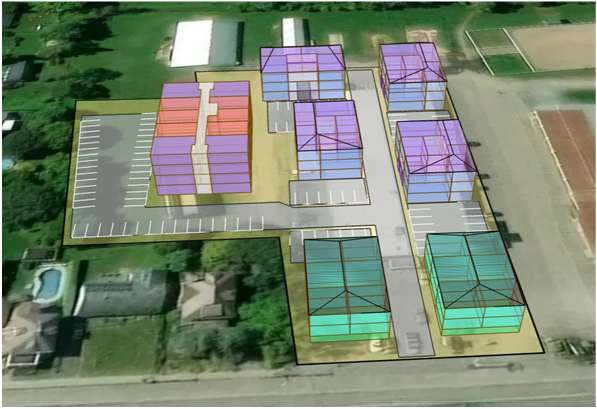
Russell Township council has given an Ottawa nonprofit housing developer a cool reception to its proposal to tear down the municipality’s arenas and build up to 267 housing units including a potential six-storey building on the site of the Russell Arena.
Sébastien Dagenais, director of corporate services-treasurer, also proposed that students in Ottawa from La Cité College could build housing units and have them transported to a third proposed Marionville construction site. There was no mention made of whether or not the proposed multi-location construction project would produce any employment for Russell Township.
The proponents suggested that Russell Township waive its property taxes, building and zoning fees, and donate the land, estimated to be worth more than $1.5 million. The plan also involves razing the Camille Piché Community Centre and building 16 housing units in Marionville near the water tower. No mention was made of building affordable housing in Limoges.
CAHDCO discussed possible municipal contributions but did not put a dollar figure on that support. A June 2025 township report estimated the combined land-sale value of the two arena properties, including the Embrun community hall, at $1.544 million.
But the Oct. 13 presentation quickly raised questions about whether the municipality was getting ahead of its public consultation process when a map of the Russell Arena property appeared to include land belonging to the Russell Agricultural Society.
“We've gotten concerns from the Ag Society regarding the process of inclusion in the discussions for these properties,” Coun. Jamie Laurin told council.
“To have a separate group come in and make a presentation to us outside of that process just feels like we're doing something untoward,” Laurin said later in the discussion.
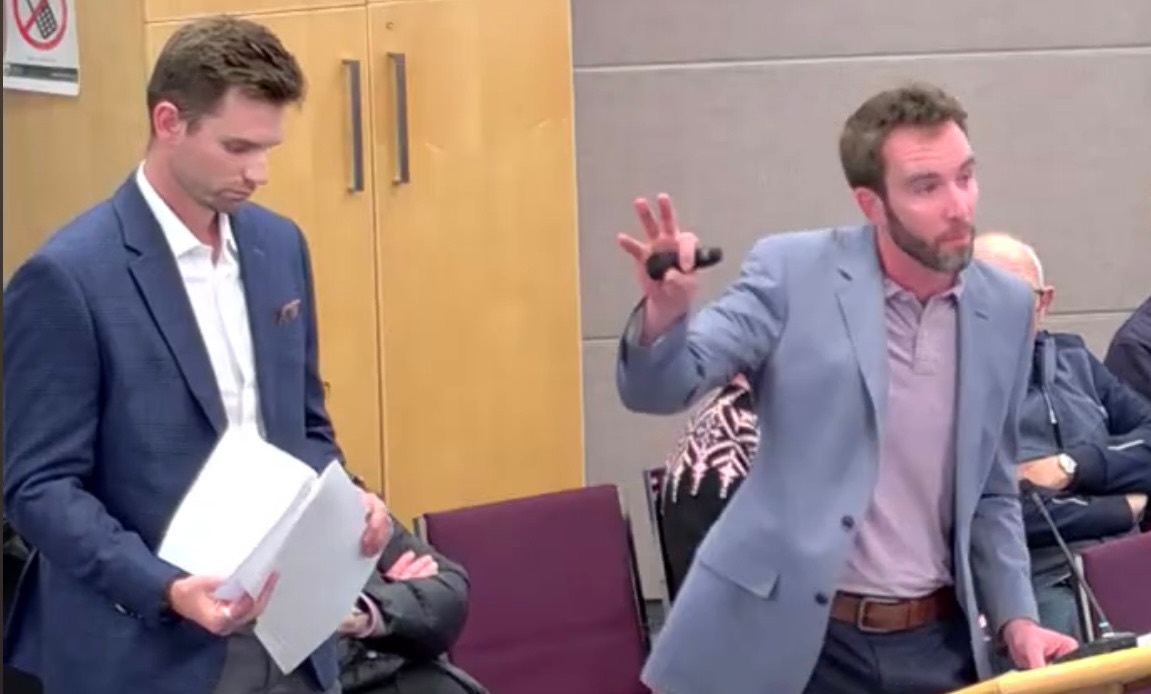
Representatives Adrian Schut and Warren Vibert-Adams told council CAHDCO has worked with municipalities and nonprofit organizations on affordable and non-market housing development across Eastern Ontario. They emphasized that their concepts were preliminary exercises in determining what could fit on municipal land and not applications for development approval. CAHDCO suggested a combination of apartment buildings and stacked housing could potentially accommodate up to 112 units for the Russell Arena property. Its concept for the Embrun Arena and Camille Piché Community Centre property could accommodate 139 units using several types of residential buildings.
The presentation nevertheless drew immediate concern from Mayor Mike Tarnowski who questioned the boundaries shown around the Russell Arena property. Tarnowski said council had no plans to take land from the Agricultural Society. Administration acknowledged that the boundaries provided for the exercise appeared to require correction.
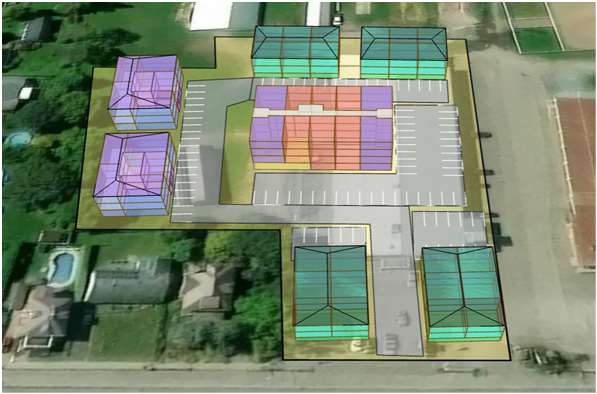
Laurin questioned why the concepts were being presented while consultant 2B was already conducting a study of the future use of municipal properties. Administration said CAHDCO had already presented its housing concepts to 2B.
“I just find the timing odd for some of the properties that are being discussed in this report. I appreciate the report, and don't get me wrong, I think it's it's very important that we look at these types of partnerships. But knowing what we know about ... the two arena properties. When we have a use study going on right now, and to have a separate group come in and make a presentation to us outside of that process just feels like we're doing something untoward. And I know that's not the— that's not the expectation, or that's not the intention, but that's the feel of this to me. So I'm a little— I guess I'll use the word frustrated to see that these 2 facilities were included in this, and then to find that the property wasn't even properly presented to them, that would have concerns for the Ag Society.”
Staff said administration attended a conference where CAHDCO gave a presentation. Chief administrative officer Richard Godin said CAHDCO also presented its housing ideas to the consultants reviewing the future of the township’s recreation properties and the proposals were brought to council so councillors and the public could see what was being considered.
Godin said the study included consultation with municipal departments about different service needs and affordable housing was one of the needs identified.
“Bringing it to council now is just to ensure transparency, and so the council and the public is also aware of things that are being looked at,” Godin said.
“I just wanted to mention though the timing of it, it’s necessary that it comes now because we are doing that site study and they’re not being done, like we mentioned previously, in silos. This is really something that was being worked on [from] the administration standpoint. And part of the consultation for the— with the 2B development for the future of the arena, obviously there’s a lot of public consultation, there’s consultation with council members, but there’s also consultation with every department just regarding different service needs, and this is one that was identified, and there was a kind of a presentation done to the consultants on this, and bringing it to council now is kind of just to ensure transparency and so the council and the public is also aware of things that are being looked at. So just explaining kind of the background and what led to today’s presentation.”
Coun. Charles Armstrong said affordable housing was needed in the township but argued that redevelopment should also preserve community uses. He asked whether a property could incorporate community facilities on the ground floor and housing above. The CAHDCO representatives said mixed-use buildings were possible but could require dedicated municipal funding or other financial support for the non-residential space.
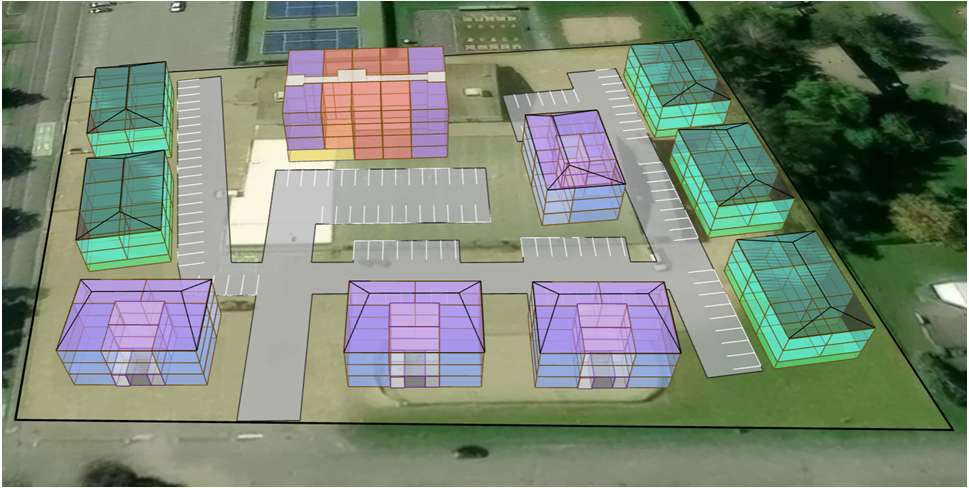
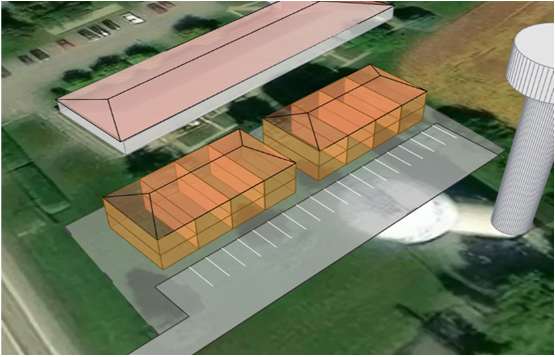
Marionville prompted a separate debate about whether an affordable housing project would make sense in a community with limited commercial services, no public transit and no municipal sewer service. The smaller Marionville site near the water tower was identified as a possible location for eight ground-level accessible homes potentially suitable for seniors or people with mobility limitations.
Tarnowski questioned the practicality of that location while Armstrong noted the servicing problem. CAHDCO suggested that a modest-income development for people with vehicles might be more suitable than deeply subsidized housing.
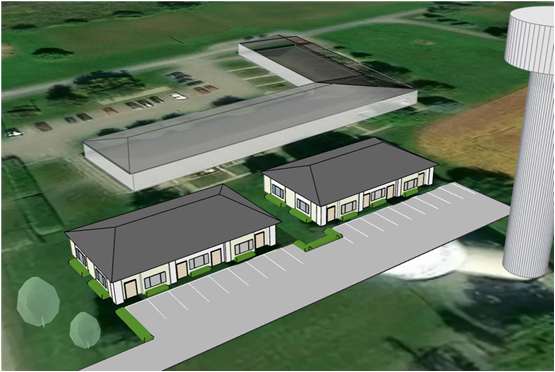
The initial Marionville concepts showed one-storey accessible townhouses with ample parking or an alternative layout of 16 units in two-storey stacked townhouses.
The housing layout would have to account for existing underground services connected to the water tower. Schut cautioned that the preliminary illustrations were intended to explore possibilities rather than prescribe developments.
Coun. Lisa Deacon asked whether buying and preserving existing affordable apartments might sometimes make better economic sense than constructing new units. CAHDCO representatives agreed that both approaches should be considered.
Later in the meeting, council voted to allow administration to continue exploring the Marionville site's feasibility with CAHDCO, with staff to report back before any commitment to proceed. That authorization was limited to further investigation. No construction, municipal project funding or disposal of municipal land was approved through that decision. Administration said any subsequent report would need to address local demand, costs, financing and the identification of an organization capable of operating the housing.
The Oct. 13 presentation and accompanying staff report provided no construction budget for any site, no combined total, no land valuation and no dollar value for proposed tax exemptions or waived fees. The developers said potential sources of support included federal assistance through Build Canada Homes, other project financing and municipal contributions. Municipal options discussed at the meeting included land, capital or predevelopment assistance, property-tax exemptions and waived planning or permit fees. They discussed possible sources of financial support but did not present a financing plan with committed funding or specify the dollar value of the proposed municipal contributions. The township’s housing action plan contains cost estimates for policy measures and implementation work but no construction budgets for these proposed housing projects.
The township's June 23, 2025 report titled Reimagining the Role of Existing Recreation Facilities gave approximate land-sale values based on estimates supplied by a qualified appraiser of $530,000 for the Russell Arena property and $1.014 million for the Embrun Arena and community hall property, a combined $1.544 million. It estimated demolition costs of $175,000 in Russell and $267,000 in Embrun, leaving corresponding net amounts of $355,000 and $747,000.
The plans leave unresolved who would own or operate the housing and whether municipal land would be donated, leased or retained. An operator would be the organization responsible for running the housing, including leases, rent collection and maintenance. It could be a nonprofit organization or a private company. No operator has been selected.
Council approved the recreation-property review by consultant 2B on May 25, 2026, awarding a $253,080 contract plus HST within a $270,000 budget.
CAHDCO is an Ottawa nonprofit housing development organization created in 1996 by Centretown Citizens Ottawa Corporation (CCOC), a nonprofit housing owner and landlord. Its name originally stood for Centretown Affordable Housing Development Corporation but the organization now uses CAHDCO as a standalone name. The two organizations have different roles. CAHDCO has paid staff who help clients assess whether housing projects are feasible, assemble financing and manage development. Its nonprofit status does not mean its services are free, nor does its involvement mean it will be the construction contractor or own and operate the finished homes.
Its completed work includes development consulting for Multifaith Housing Initiative’s 98-home Haven project in Barrhaven, which welcomed residents in 2017, and project management for the same organization’s 40-unit Veterans’ House in Ottawa, which began welcoming residents in 2021. Those projects illustrate CAHDCO’s role in helping other housing organizations turn proposals into completed homes, rather than serving as the builder or landlord for every project in its portfolio.